
Frontend Interview Study Plan Guide – 2025

This guide outlines a suggested four-month plan for preparing for your front-end interviews. However, if you’re crunched for time, don’t worry – we also offer shorter plans, ranging from two weeks to three months. You can find them here. Front-end interview preparation is crucial, and this study plan addresses it by providing a structured approach to help you succeed. Follow this frontend interview study plan week by week, using MDN Web Docs as your main reference.
High-level diagram overview of the study plan:
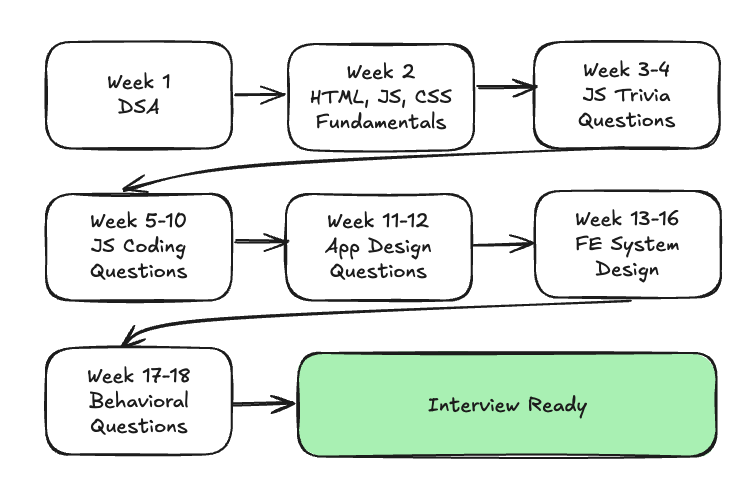
Week 1: Data Structures and Algorithms
Focus on:
-
Stacks and queues
-
Basic tree traversal (in-order, pre-order, post-order)
-
Hashmaps and their applications
-
Recursion and memoization
-
Big O notation for analyzing time and space complexity
The goal isn’t to become an algorithm wizard. It’s to become fluent with the patterns that appear repeatedly. Frontend interviews generally tend not to focus on heavy DSA questions. However, it’s still crucial to know the fundamentals because even those frontend-oriented questions will come with a DSA twist.
You can use this guide to prepare for frontend data structures and algorithms, specifically for frontend interviews.
Week 2: JavaScript, HTML, and CSS Fundamentals
Once your DSA foundation is in place, shift your focus to the building blocks of the web.
Learn and revisit:
-
JavaScript array and object methods
.map(),.reduce(),.filter() -
Strict equality vs type coercion
-
Closures,
this, and scope -
Functional programming concepts
-
Object-oriented JavaScript
-
CSS layout basics (Flexbox, Grid, positioning)
-
HTML semantics and accessibility principles
If you don’t fully understand the language or the browser, frameworks won’t help you.
Weeks 3-4: JavaScript Trivia Questions
Now that you’ve got a solid technical base, it’s time to prepare for explaining what you know.
Practice clear explanations for:
-
Closures
-
Call vs Apply vs Bind
-
Event delegation
-
Hoisting and the temporal dead zone
-
Async behavior (Promises, async/await, event loop)
These types of questions don’t just test your memory; they test how well you understand what’s happening under the hood.
You can find a complete list of expected JavaScript trivia questions here.
Weeks 5-10: JavaScript Coding Problems
Start applying everything you’ve learned. These next few weeks are all about writing code, debugging, and improving your problem-solving speed.
Tackle problems like:
-
Debounce and throttle implementations
-
Custom promise polyfill
-
Implementing
map,filter, andreducefrom scratch -
Memoization utilities
-
Deep cloning an object
Balance your practice between UI-focused tasks and pure logic problems.
The complete list of JavaScript coding problems can be found here.
Weeks 11-12: App Design with Vanilla JS and React
You’ve learned the concepts. Now, show you can build real things.
Create a few small projects:
-
To-do list app
-
Image carousel or photo gallery
-
Modal and tooltip components
-
Search autocomplete with filtering
-
Tic-tac-toe or simple games
Build them in both vanilla JS and React. You’ll gain deeper insights and be ready for whatever the interview throws at you.
The complete list of JavaScript app design problems can be found here.
Weeks 13-16: Frontend System Design
This is where senior and staff interviews start to shine.
Study how to:
-
Gather requirements effectively
-
Break down the frontend architecture into modules and components
-
Design data flow and state management
-
Compare REST vs GraphQL for API needs
-
Optimize performance (lazy loading, caching, etc.)
-
Design for accessibility and responsiveness
Be prepared to discuss trade-offs and justify your decisions.
The complete list of Frontend System Design problems can be found here.
Week 16+: Behavioral Interview Prep
Don’t let this be an afterthought. Behavioral rounds carry significant weight.
Practice using the STAR format:
-
Situation: Set the context
-
Task: What did you need to do
-
Action: What you did
-
Result: What happened and what you learned
Focus on stories that show ownership, communication, and growth. This is your chance to show who you are beyond code.
The complete list of behavioral questions can be found here.
Offer Negotiation
Once you’re done with interviews, the final step is just as important: know your worth and be ready to negotiate.
-
Never give your number first
-
Time your interviews so you get offers around the same week
-
Use competing offers as leverage
-
Always negotiate total comp, not just base salary
Negotiation isn’t about being aggressive. It’s about advocating for your values.
A free negotiation guide for offer negotiations can be found here.
Final Thoughts on Your Frontend Interview Study Plan
Prepping for frontend interviews is no joke. It takes consistency, focus, and a plan. But the upside is enormous: top roles, better compensation, more fulfilling work.
I highly recommend following this guide, as it successfully helped me land several top-of-the-band job offers when I prepared. My journey led me to build this platform to help others. If this is something you’d like to learn more about, you can read more about it here.