
The Front-End Interview Process Explained
If you’re applying for frontend roles, especially at mid to large tech companies, the interview process tends to follow a predictable structure. Once you understand how it’s designed and what each round is testing, it becomes a lot easier to prep intentionally instead of randomly grinding Leetcode. For company-specific details, interview reviews on Glassdoor are a useful supplement.
Here is a high-level representation of the average frontend interview process:
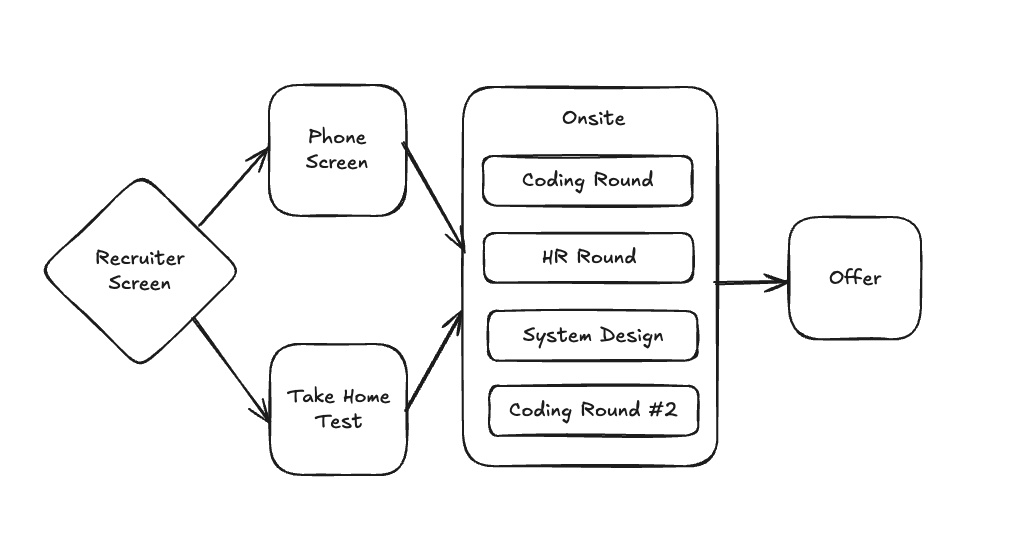
Let’s walk through the process using the exact flow most companies follow, from recruiter screen to final offer.
1. Recruiter Screen
This is your first point of contact. It’s not technical (for the most part, Meta recruiters quiz frontend trivia questions).
The recruiter wants to confirm a few basics:
-
Are you actively looking?
-
Do you meet the minimum role requirements?
-
What’s your timeline and salary expectations?
This round is all about communication and clarity. Be honest, concise, and make it easy for them to move you to the next step.
2. Phone Screen or Take-Home Test
After the recruiter screen, companies usually go one of two ways depending on the size and structure of their team:
Option A: Take-Home Test (common in startups and mid-size companies)
You’ll be given a minor feature or mini-app to build, usually with React, and asked to complete it over a few days.
What they’re looking for:
-
Code quality and structure
-
UI polish and design sense
-
Clear naming, reusable components, and clean layout logic
-
Scalable code
- Considering out-of-scope elements (think caching, normalization, etc)
Tip: Keep it scoped. Don’t overbuild. Write a short README and explain your thought process if you can.
Option B: Technical Phone Screen (standard in big tech)
This typically involves a 45- to 60-minute live coding round using a tool like CoderPad or HackerRank.
You’ll be asked a frontend-focused coding question, often with a light algorithmic twist.
Examples:
-
Implement debounce or throttle in JavaScript
-
Build a simple search box with filtering
-
Solve a problem that uses maps, sets, or recursion
What they’re looking for:
-
Can you code fluently under pressure?
-
Do you understand JS fundamentals?
-
Can you explain your thought process clearly?
If you pass this, you will move on to the onsite round.
3. Onsite (3 to 5 Rounds Total)
The onsite is where most of the objective evaluation happens. Depending on the company, you’ll typically go through a mix of the following rounds:
Round 1: Coding Interview
You’ll solve one or two problems using JavaScript, usually frontend-relevant, but still testing your ability to break down logic, write clean code, and test edge cases.
Expect:
-
DOM or UI logic problems
-
Array or string-based algorithm challenges
-
Utility functions or stateful logic
- The top 90 coding round questions can be found here
Round 2: Frontend System Design
Especially at senior levels, you’ll be asked to design a scalable frontend architecture.
Examples:
-
Design a newsfeed for Facebook
-
Architect a dashboard app with filters and pagination
-
Handle optimistic UI updates and error states
- A comprehensive, free, and in-depth guide to preparing for frontend system design interviews can be found here.
They want to see:
-
Your ability to break down complex apps
-
Tradeoffs you consider between frameworks, state management, and performance
-
How do you think about modularity, testing, and scalability
Round 3: App Design or Live Coding
You may be asked to build a real UI component or app live.
This round evaluates:
-
Component design
-
React or vanilla JS fluency
-
Layout, styling, and rendering logic
-
Clear thinking under time pressure
- Live coding round questions can be found here.
Keep things structured and talk out loud. Interviewers care as much about your thought process as the final result.
Round 4: Behavioral or Hiring Manager Round
This round is often underrated but extremely important. It’s where they assess whether you’re a strong communicator, teammate, and a good cultural fit.
Expect:
-
“Tell me about a time you…” questions
-
Questions about your resume or recent projects
-
Team conflict, ownership, or leadership examples
- Behavioral questions can be found here.
Use the STAR format:
Situation, Task, Action, Result. Keep it clear and structured.
Optional Round 5: Second Coding Round
Some on-site interviews include a second technical round, either focusing on a different type of problem or delving deeper into your strengths or areas for improvement from the earlier round.
4. Offer Stage of the Frontend Interview Process
If you’ve made it this far, congratulations. You’ve done the hard part.
Before you say yes:
-
Try to time your interviews so offers land around the same week
-
Never give a salary number first. Ask for their range
-
Use offers as leverage if you’re interviewing at multiple places
-
Don’t lie about other offers, but do advocate for yourself
The offer stage is a game, too. Play it well, and you can see big jumps in total comp just by knowing how to navigate the negotiation.
Feeling overwhelmed? Don’t worry, the following guide will help you prepare in a structured manner using study plans.