
The Front End Interview Handbook – 2027
If you’ve landed on this platform, there’s a good chance you have a front-end interview coming up, or you’re thinking about diving into the interview process and have been bouncing around the internet looking for some structured guidance and resources. This front end interview handbook is that guidance in one place.
Unlike traditional software engineering interviews that lean heavily on Leetcode-style algorithm problems, front-end interviews are a different beast altogether.
You might be asked domain-specific questions, such as how the CSS box model works or the role of semantic HTML, or be asked to build a small React app that fetches data. At the same time, you could just as easily be asked to reverse a linked list, invert a binary tree, or design a full-scale frontend system. In short, anything’s fair game, and that unpredictability can be overwhelming.
Our Purpose With This Front End Interview Handbook
This platform was created to provide engineers with a structured, no-nonsense roadmap for navigating the front-end interview process.
I’ve personally conducted hundreds of front-end interviews for top tech companies and been on the other side of the table interviewing for roles myself. Additionally, the FrontendLead community contains thousands of engineers who have shared their interview experiences, patterns, and preparation strategies.
This handbook is built from all of that collective insight. Whether you’re a new grad, a mid-level engineer looking to level up, or a principal preparing for senior loops, this guide is here to help you walk into interviews with clarity and confidence.
Is This Handbook Right for You?
The Frontend Interview Handbook is designed to help existing frontend engineers (whether you are a new grad or a principal engineer) prepare for frontend interviews. So, you are expected to have some experience in frontend engineering.
Before jumping into interview preparation, it is essential to be familiar with the core building blocks of frontend development.
Here’s a quick checklist of what you’re expected to know walking in:
| Category | What You Should Know |
|---|---|
| HTML | Basic understanding html tags like <p> <div> <section>How HTML layout works Attributes like id, class, alt, href, and custom data attributes |
| CSS | Basic alignment items using Flexbox and Grid Casic styling elements using CSS |
| JavaScript | Basic knowledge of writing functions and using variables Basic understanding of DOM manipulation and event handling Nice to have: standard array methods like map filter reduceNice to have: working with async code using Promises and async/await |
| React | Basic React knowledge, building functional components Using hooks like useState and useEffectUnderstanding props, state, and component hierarchy Basic JSX and component composition |
Consider this example:
import { useState } from 'react';

function Counter() {
  const [count, setCount] = useState(0);

  const increment = () => {
    setCount(count + 1);
  };

  return (
    <div style={{ textAlign: 'center', padding: '2rem' }}>
      <h1 style={{ fontSize: '2rem', color: '#333' }}>
        Count: {count}
      </h1>
      <button
        onClick={increment}
        style={{
          padding: '0.5rem 1rem',
          fontSize: '1rem',
          backgroundColor: '#007bff',
          color: '#fff',
          border: 'none',
          borderRadius: '4px',
          cursor: 'pointer'
        }}
      >
        Increment
      </button>
    </div>
  );
}

export default Counter;
Quiz yourself on the example above: Do you understand this code? If the answer is no, don’t worry – we’ve got you covered with free beginner guides to learn HTML, CSS, JavaScript, React JS, and Data Structures and Algorithms knowledge required for Frontend Interviews.
Otherwise, you are ready to continue preparing using the Front-End Interview Handbook.
Table of Contents
- Overview
- Fundamental Knowlege
- Frontend Interview Playbook
- Frontend Interview Process Explained
- Frontend Interview Question Type by Company
- Recommended Study Plan
- HTML Interview Questions & Answers
- CSS Interview Questions & Answers
- JavaScript Interview Questions & Answers
- React JS Interview Questions & Answers
- Frontend Trivia Questions & Answers
- Build a Small Frontend App: Style Questions & Answers
- Frontend System Design Questions
- Design Patterns in React
- Behavioral Questions & Answers
- Salary Negotiation
- How to not screw up the negotiation
What does a frontend engineer do?
Front-end engineers, also known as front-end developers, create the visual elements of an app or website. They design the user-facing content that users see and interact with.
They’re the ones behind the layout of a landing page, the feel of a button when you hover over it, and how smoothly a mobile nav menu slides open. Their work is where code meets design. It’s about making things look good, feel good, and work.
Do you need a degree in computer science?
Not at all.
Many frontend engineers come from traditional computer science backgrounds, but just as many do not. Some started in design, others in teaching, marketing, or completely unrelated fields. Many of them either taught themselves or acquired skills through coding boot camps.
The one thing they all have in common is this: they built projects. They got their hands dirty. In frontend, what matters is your ability to ship clean, usable interfaces, not where you went to school.
The core tools you’ll use
Most frontend engineers today work with React, a JavaScript framework that enables the easy development of fast and interactive web applications. It is especially common at more prominent tech companies.
But not everyone uses React. At smaller companies or in older codebases, you might run into Angular, jQuery, or even plain HTML, CSS, and JavaScript.
That’s why the fundamental foundation for any frontend engineer is what I call the three sacred tools:
-
HTML for structure
-
CSS for styling
-
JavaScript for interactivity
Frameworks come and go. These three never change.
What are the differences between the frontend and the backend?
| Frontend Engineer | Common Skills | Backend Engineer |
|---|---|---|
| Builds user interfaces with HTML, CSS, JavaScript, and React | Writes clean, maintainable, and testable code | Builds scalable APIs and services using Node.js, Go, Java, or Python |
| Focuses on responsive design and performance | Understands computer science fundamentals (DS & Algos) | Optimizes database queries and system performance |
| Implements animations, state management, and accessibility | Uses Git and CI/CD pipelines | Handles authentication, authorization, and data security |
| Works closely with design and product teams | Participates in code reviews and architecture discussions | Integrates third-party APIs and manages cloud services |
| Uses browser dev tools and performance profiling | Follows Agile or Scrum development processes | Monitors and logs backend errors and metrics |
Frontend engineers build everything the user sees and touches. Backend engineers build what powers all of that behind the scenes.
A frontend engineer might build the form. A backend engineer handles what happens after you submit it.
Frontend is about layout, responsiveness, polish, and design systems. Backend is about databases, APIs, infrastructure, and data flow.
They both require strong problem-solving skills, but the flavor of those problems is different. Frontend is about the user experience. Backend is about what happens under the hood.
Is frontend engineering right for you?
If you’ve got a creative eye and enjoy design as much as development, frontend might be your sweet spot.
Frontend is an excellent fit for people who care about visual detail and want to build things that users see. It’s the part of software engineering where creativity and logic go hand in hand.
You might love frontend if you:
-
Enjoy making things look polished and beautiful
-
Like tweaking UI components until they feel just right
-
Find joy in responsive design and animations
-
Prefer working closely with design teams
Compared to the backend, which is often more data-heavy and logic-focused, the frontend gives you a bit more room to express your design sense while still solving challenging technical problems.
Next, let’s discuss the earnings of frontend engineers.
Front End Engineer Salary in the United States 2025
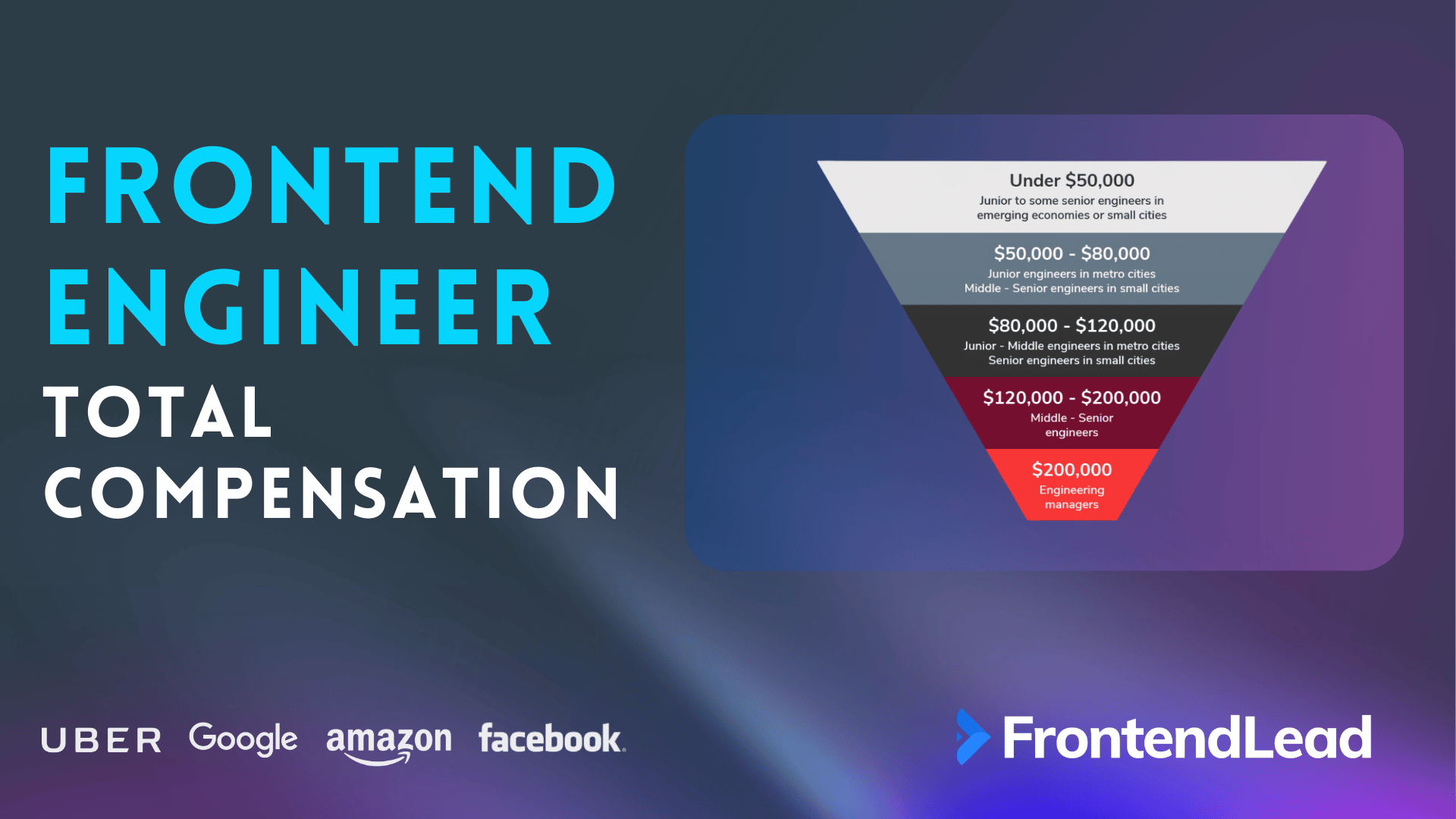
For front-end developers in the United States, the compensation varies based on experience, location, and the specific company.
Generally speaking, if you live in a tech hub, such as San Francisco, Seattle, or New York, your salary as a software engineer (frontend) will include:
- Base salary
- Stock options
- Possible signing bonus
- Possible relocation bonus
- Other company perks (free lunches, 401k match, etc..)
Here are some key salary metrics (base salary only):
- Median Salary: Typically around $153,000 per year, indicating that half of all front-end developers earn more than this amount, and half earn less (levels.fyi).
- High Salary: Salaries can reach as high as $210,000 per year for top earners in specific regions or with extensive experience (levels.fyi).
- Top 1% Salary: At the 90th percentile, you can expect to earn as much as $270,000 per year (levels.fyi).
Stock Options
Stock options are a common component of compensation packages in tech companies, particularly in startups and large, publicly traded tech firms. The value of stock options can vary greatly:
- Startups might offer stock options that could be highly lucrative if the company goes public or is acquired.
- Established companies, such as those in the FAANG (Facebook, Apple, Amazon, Netflix, Google) group, typically provide RSUs (Restricted Stock Units) as part of their compensation packages. The value can range from $50,000 to over $200,000 annually, depending on the company’s stock performance and the seniority of the position.
Signing Bonuses
Signing bonuses are used to attract top talent and can make a significant impact on the total compensation package:
- For front-end developers, especially in competitive markets like San Francisco or New York, signing bonuses... premium content.


